Winsen GMV-2021B MEMS Hydrogen Sensor
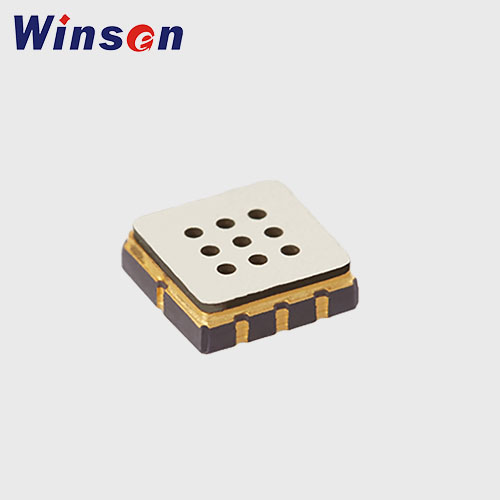
Compact MEMS MOS sensing element for hydrogen leak and energy-storage applications.
Manufacturer: Winsen
Technical specifications
| Target gas | Hydrogen |
|---|---|
| Typical range | 0.1–1,000 ppm |
| Technology | MEMS MOS |
| Heater power | ≤50 mW (manufacturer model specification) |
Manufacturer documentation
Official product information / technical documents →
Verify exact gas configuration, part number, calibration, response, environmental limits and applicable safety certification before equipment design-in. Product data can change between revisions. AirAlign is independent of the listed manufacturer.
GMV-2021B — heated MEMS hydrogen element
The GMV-2021B is a MEMS metal-oxide hydrogen sensing component with a low-power heater, rather than the ZE630 electrochemical module. Its response needs heater-drive and resistance-readout electronics, stabilization and a gas-specific conversion algorithm. The listed low-ppm response class and heater power must be checked at the actual operating temperature and gas mixture. For industrial hydrogen alarms, validate the complete detector’s calibration, poisoning behaviour, fault supervision and hazardous-area approvals separately.
GMV-2021B — MEMS-MOS H₂ resistive sensor with separate heater — technical model review
Source-specific manufacturer specifications, test conditions and practical engineering distinctions. The stated model/range is not a blanket safety approval or a guarantee that related part codes perform identically.
| Parameter | OEM documentation | Engineering interpretation |
|---|---|---|
| Physical process | MEMS metal-oxide-semiconductor resistance responds to H₂ | Not a calibrated UART ppm transmitter like ZE630-H₂. |
| Detected hydrogen band | 0.1–1,000 ppm | Calibration and nonlinearity must be addressed by OEM analogue front end. |
| Loop supply | Sensing circuit voltage VC no greater than 24 V DC | Separate from sensor heater voltage requirement. |
| Heater supply | 2.5 ±0.1 V AC or DC, about 80 ±5 Ω at room temperature | A 5 V/24 V rail would exceed the specified heater condition. |
| Heater dissipation | ≤50 mW | Low power still requires active heating and stabilization. |
| Sensitivity/resistance | 1–30 kΩ at 200 ppm H₂; R₀(air)/Rs(200 ppm) ≥5 | Sensor resistance ratio is not direct ppm accuracy. |
| Factory calibration | Winsen notes bare elements undergo outgoing test but module-level calibration differs | Design-in ageing/preconditioning and field gas-reference calibration. |
| Qualified applications | Hydrogen vehicles, lithium battery packs and energy storage | Ex/HazLoc product approval not proven by this component datasheet. |
Installation, electronics and calibration
For a low-power battery room sensor array, GMV-2021B can give early H₂ rise information when its MOS heater and analogue conditioning are designed correctly. Calibrate the nonlinear resistance response at known ppm concentrations, test poisoning/humidity effects and avoid a software-only linear mapping without reference data. Battery packs can create varying airflow and thermal profiles that affect concentration distribution; locate sensors based on leakage paths. Compare with the electrochemical ZE630-H₂ because the two sensors need fundamentally different host electronics and test programs.
Original manufacturer technical source: Official product specifications and primary data sheet. Exact orderable variant, gas and current certificate must govern procurement or any safety function.
AirAlign manufacturer-specific editorial review · 25 October 2026. Detailed integration information is not an independent calibration or Ex/ATEX/IECEx signoff.