Figaro TGS2602 — VOC & Air Contaminant Sensor
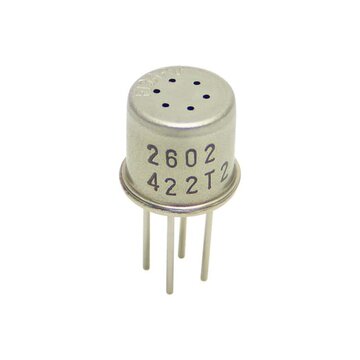
Indoor air contaminant sensing component responsive to various VOC and odorous gases. It is a broad response sensor rather than a compound-specific laboratory VOC analyzer.
Manufacturer: Figaro Engineering
Technical overview
| Sensing principle | Metal oxide semiconductor (MOS) |
|---|---|
| Target | General air contaminants: VOCs, ammonia and H₂S responses |
| Typical reference gas range | 1–30 ppm ethanol equivalent |
| Heating power | Approx. 280 mW (manufacturer product information) |
| Typical applications | Air purifiers, ventilation control and indoor air-quality indicators |
Manufacturer documentation
Verify latest datasheets and detector-level safety compliance. A raw sensor element is not a certified finished alarm.
VOC indicator versus compound-specific gas measurement
TGS2602 is a broad-response metal-oxide component for indoor air-contaminant indications. Its 1–30 ppm ethanol-reference response cannot be represented as a universally accurate total-VOC measurement for every mixture. Different VOCs and odorous gases can trigger a different resistance response; algorithm training, heater operation and environmental compensation determine the meaning of an IAQ index.
For an air purifier or demand-control system, verify response time, humidity/temperature effects, filter exposure and background contamination under real conditions. When an application requires an identifiable compound concentration or a regulated occupational limit, choose an instrument calibrated and validated for that gas rather than re-labeling a broad VOC-response module.
Figaro TGS2602-B00: source-specific circuit and sensing data
The manufacturer’s TGS2602-B00 is a thick-film MOS air-contaminant sensor in a TO-5 can. The reference range 1–30 ppm ethanol equivalent is a characterization range, not a selective total-VOC concentration meter. Toluene, ammonia, H₂S and other gases each produce their own sensitivity curve.
| OEM specification (Rev. 01/24) | Manufacturer value | Design consequence |
|---|---|---|
| Heater VH / circuit VC | 5.0 ±0.2 V DC for both; sensor-electrode dissipation ≤15 mW | Separate heater consumption from signal-load power; maintain the DC polarity of VC. |
| Heater current and power | 56 ±5 mA, approximately 280 mW; heater about 59 Ω at room temperature | Regulator must supply this continuous heater load; not a passive microampere IAQ sensor. |
| Load resistor / baseline | RL adjustable, minimum 0.45 kΩ; sensor RS 10–100 kΩ in clean air | Read analog load voltage and derive RS; there is no inherent UART, I²C, ppm-register or 4–20 mA output. |
| Factory sensitivity / conditioning | RS(10 ppm ethanol) / RS(air) = 0.08–0.5; manufacturer test conditioning ≥2 days | Manufacturing test conditioning is not a promise that readings become accurate immediately after system power-up. |
What an IAQ reading means
Because RS decreases in the presence of different reducing vapours, a simple single-gas conversion cannot identify mixed indoor pollutants. Build an application-specific baseline and temperature/RH compensation model, account for fresh-air drift, and test the actual ventilation or air-cleaner logic. The reported lithium-ion battery application is a manufacturer-listed use case, not evidence that the bare component constitutes an approved battery thermal-runaway protection detector.
Original Figaro sources: TGS2602 product information Rev. 01/24; technical information Rev. 09/24; official model page.